26 January 2026
EASAC Commentary:
Nature Restoration is a Strategic Investment in Europe’s Security, Prosperity, and Ecological Stability
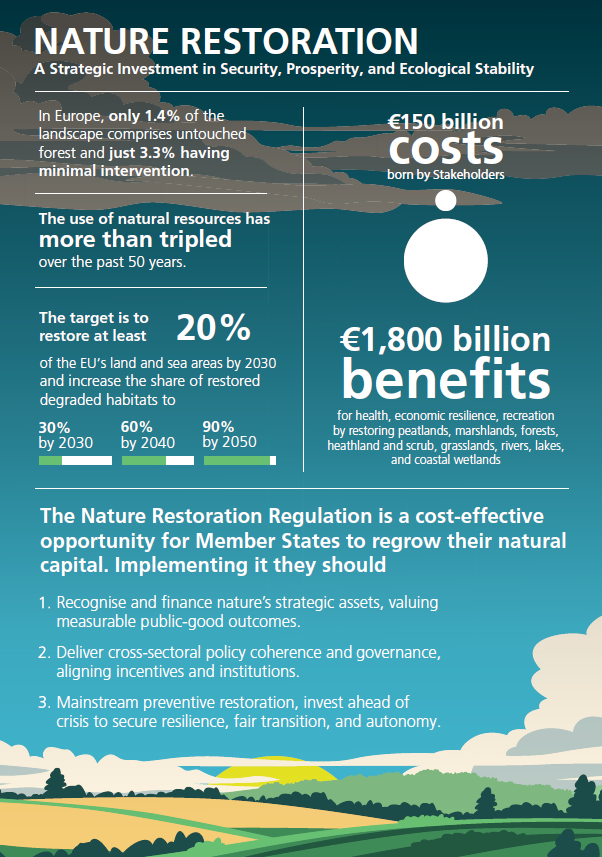
A new scientific commentary from the European Academies Science Advisory Council (EASAC) argues that implementing the EU Nature Restoration Regulation is a cost-effective investment in Europe’s security, economic resilience, and public health, not simply an environmental obligation.
The Commentary entitled ‘Opportunities in Nature Restoration’ finds that the estimated cost of restoring Europe’s degraded ecosystems is outweighed by benefits at least ten times higher, through avoided disaster losses, improved public health, greater climate resilience, and strengthened food and water security.
“Nature restoration is not an environmental luxury. It is basic risk management,” says Prof Thomas Elmqvist, EASAC Environment Director and lead author of the report. “At a time when Europe is spending billions responding to floods, droughts, wildfires, and health impacts, restoring ecosystems is among the smartest preventive investments we can make.”
The Commentary identifies immediate, high-impact restoration actions in three key ecosystems: agricultural landscapes, forests, and peatlands.
• Forests. The forest carbon sink is weakening due to climate stress and harvest pressure. Close-to-nature forestry, mixed-species and mixed-age stands, habitat protection, and landscape-level fuel management can reduce wildfire risk and rebuild resilience. Bioenergy incentives should prioritise genuine residues and cascading use of biomass, while restoring forest carbon stocks to meet land use, land use change, and forestry targets.
• Peatlands. Rewetting drained peatlands can sharply cut emissions, lower wildfire risk, improve water retention, and restore biodiversity.
The Commentary highlights three core messages:
2. Deliver cross-sectoral policy coherence and governance. Nature restoration cannot be delivered in isolation. It requires coherence across agriculture, forestry, water, energy, marine, and urban systems, supported by clear institutional mandates and accountability.
3. Mainstream preventive restoration as the most effective and efficient way to reduce disaster risks, protect assets, shield our economy against climate extremes, and enhance Europe’s resilience and strategic autonomy.
„Opportunities in Nature Restoration” full report is available here
Romanian Academy is a member of EASAC.
The European Academies Science Advisory Council (EASAC), founded in 2001 at the Royal Swedish Academy of Sciences, is formed by the national science academies of the EU Member States, Norway, Switzerland, and the United Kingdom, to collaborate in giving advice to European policymakers. Through EASAC, the academies work together to provide independent, expert, evidence-based advice about the scientific aspects of European policies to those who make or influence policy within the European institutions. More details here
EASAC Infographic